Bleach in a dosing tank
Record actual hypochlorite concentration, normal/maximum temperature and cleaning liquids. Request the PTFE-family review; do not approve stainless, diaphragm or seals from housing alone.
Chemical tank example →LIQUID → COMPLETE WETTED ASSEMBLY
Search liquid review paths, compare PUR, PE and FEP cable, and prepare a complete wetted-material request with temperature, seals and concentration.
SEARCH 50 LIQUID REVIEW ENTRIES
Review paths, not tested chemical ratings. No density is inferred.
PRELIMINARY ENQUIRY PATH — NOT MATERIAL APPROVAL
The RFQ keeps your named liquid, seal and existing jacket in notes. Any proposed family/jacket is still subject to complete assembly review. Enter actual density, head and cable route there.
THE WHOLE WETTED STACK
Review the normal liquid, contaminants and cleaning exposure against the complete assembly. A PTFE body, titanium label or FEP cable does not qualify the diaphragm, seal compound, feedthrough, internal isolation system or final termination. Use the directory to prepare this review, then obtain the configured material schedule and permitted operating conditions.
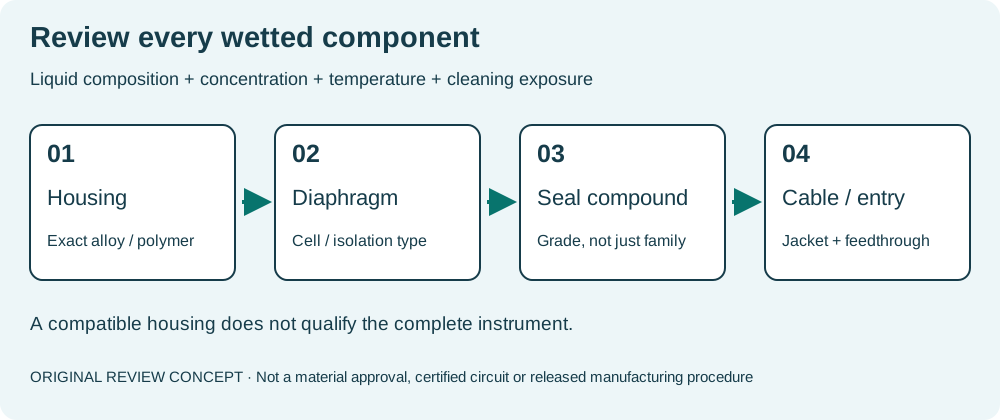
| Part exposed to liquid | What to identify | What is still needed |
|---|---|---|
| Housing / nose | Exact metal alloy or polymer grade; exposed fasteners | Composition, temperature, exposure and corrosion evidence for the actual combination |
| Diaphragm / cell | Ceramic grade, metallic membrane or isolation construction | Chemical, abrasion, pressure and cleaning limits for that configured face |
| Seal / bond / feedthrough | Exact compound and all other wetted sealing materials | Compound-specific immersion data; a generic elastomer family is insufficient |
| Cable / joint | Jacket grade, continuous length, strain relief and termination | Chemical/thermal immersion, tensile and bend limits; keep the atmospheric vent open and dry |
| Jacket request | Reason to discuss it | Tradeoff / release check |
|---|---|---|
| PUR | Water and well installation request where the configured jacket suits the liquid | Identify the polyurethane grade, hydrolysis/cleaning exposure, tensile load and bend radius. Oil resistance is not universal. |
| PE | Alternative water-duty request | Check exact grade, temperature, mechanical handling and immersion. Do not assume it is interchangeable with fuel-duty cable. |
| FEP | Chemical or elevated-temperature review request | Separate the FEP base assembly and extra length price. The resin name does not qualify the complete probe or a different fluoropolymer jacket. |
PTFE, FEP and ETFE are distinct polymer families. Chemours publishes separate resin properties and directs readers to the grade-specific datasheet. Those resin data do not establish a finished cable, feedthrough or instrument rating.
Original Chemours polymer selection reference ↗| Seal family | Screening concern | Required confirmation |
|---|---|---|
| EPDM | A water-service seal must not be assumed suitable for petroleum fuel. Parker identifies a petroleum-fluid limitation. | Use the actual compound data, fuel blend, temperature and immersion conditions; do not substitute by colour or size. |
| FKM | Fuel-duty compounds exist, but Garlock identifies limitations with ketones and some other solvents. | Identify compound/grade and actual mixture; the generic FKM name is not enough. |
| FFKM | A broader chemical envelope can justify a review request; the family name still does not qualify every chemical or duty. | Request compound-specific data, seal design limits and the actual quotation. Do not assume a free or universally compatible upgrade. |
Parker polymer-family guidance (PDF) ↗
Garlock material-family limitations ↗
Material-maker references support general screening only. They do not document tests of an SLV probe. Reviewed 17 November 2026.
THREE EXAMPLES OF WHY A SINGLE GREEN CHECK IS MISLEADING
Record actual hypochlorite concentration, normal/maximum temperature and cleaning liquids. Request the PTFE-family review; do not approve stainless, diaphragm or seals from housing alone.
Chemical tank example →The seal raises a material-review flag. Keep the fuel blend and existing construction in the RFQ rather than silently replacing EPDM with an unspecified FKM compound.
Fuel tank example →Request custom engineering review. Do not move hot corrosive liquid into the ordinary high-temperature family or assume PTFE plus ceramic approves the mixture.
PTFE assembly review →50 NAMED LIQUIDS — NO INDEPENDENT TEST RATING CLAIM
These application categories and enquiry paths are editorial screening aids. Rows are not concentration-specific compatibility certificates. Unknown blends and difficult chemistry stay in custom review. Every row remains available without JavaScript.
| Named liquid | Review category | Enquiry starting path | What to confirm |
|---|---|---|---|
| Clean fresh water | Water | SLV-420 review → | Review treatment additives, drinking-water evidence if needed, temperature and every wetted part. |
| Treated drinking water | Water | SLV-420 review → | Review treatment additives, drinking-water evidence if needed, temperature and every wetted part. |
| Deionized water | Water | SLV-420 review → | Review treatment additives, drinking-water evidence if needed, temperature and every wetted part. |
| Rainwater | Water | SLV-420 review → | Review treatment additives, drinking-water evidence if needed, temperature and every wetted part. |
| River water | Water | SLV-420 review → | Review treatment additives, drinking-water evidence if needed, temperature and every wetted part. |
| Reservoir water | Water | SLV-420 review → | Review treatment additives, drinking-water evidence if needed, temperature and every wetted part. |
| Cooling-tower water | Water | SLV-420 review → | Review treatment additives, drinking-water evidence if needed, temperature and every wetted part. |
| Reclaimed water | Water | SLV-420 review → | Review treatment additives, drinking-water evidence if needed, temperature and every wetted part. |
| Clean condensate | Water | SLV-420 review → | Review treatment additives, drinking-water evidence if needed, temperature and every wetted part. |
| Seawater | Saline water | SLV-TI review → | Specify salt composition, concentration, temperature and contaminants. Review titanium grade, diaphragm, seals, deposits and contacting hardware. |
| Brackish groundwater | Saline water | SLV-TI review → | Specify salt composition, concentration, temperature and contaminants. Review titanium grade, diaphragm, seals, deposits and contacting hardware. |
| Sodium chloride brine | Saline water | SLV-TI review → | Specify salt composition, concentration, temperature and contaminants. Review titanium grade, diaphragm, seals, deposits and contacting hardware. |
| Concentrated desalination brine | Saline water | SLV-TI review → | Specify salt composition, concentration, temperature and contaminants. Review titanium grade, diaphragm, seals, deposits and contacting hardware. |
| Calcium chloride brine | Saline water | SLV-TI review → | Specify salt composition, concentration, temperature and contaminants. Review titanium grade, diaphragm, seals, deposits and contacting hardware. |
| Magnesium chloride brine | Saline water | SLV-TI review → | Specify salt composition, concentration, temperature and contaminants. Review titanium grade, diaphragm, seals, deposits and contacting hardware. |
| Municipal sewage | Wastewater | SLV-WW review → | Review solids, grease, sediment, cleaning chemicals, sensing-face geometry and hazardous-area classification. |
| Sewage sludge liquor | Wastewater | SLV-WW review → | Review solids, grease, sediment, cleaning chemicals, sensing-face geometry and hazardous-area classification. |
| Stormwater runoff | Wastewater | SLV-WW review → | Review solids, grease, sediment, cleaning chemicals, sensing-face geometry and hazardous-area classification. |
| Industrial wash water | Wastewater | SLV-WW review → | Review solids, grease, sediment, cleaning chemicals, sensing-face geometry and hazardous-area classification. |
| Diesel fuel | Fuel & oil | SLV-EX review → | Confirm actual blend, temperature, seal compound and oil-duty cable. Site classification determines approval needs; fuel alone does not classify an area. |
| HVO renewable diesel | Fuel & oil | SLV-EX review → | Confirm actual blend, temperature, seal compound and oil-duty cable. Site classification determines approval needs; fuel alone does not classify an area. |
| Biodiesel blend | Fuel & oil | SLV-EX review → | Confirm actual blend, temperature, seal compound and oil-duty cable. Site classification determines approval needs; fuel alone does not classify an area. |
| Kerosene | Fuel & oil | SLV-EX review → | Confirm actual blend, temperature, seal compound and oil-duty cable. Site classification determines approval needs; fuel alone does not classify an area. |
| Mineral hydraulic oil | Fuel & oil | SLV-EX review → | Confirm actual blend, temperature, seal compound and oil-duty cable. Site classification determines approval needs; fuel alone does not classify an area. |
| Lubricating oil | Fuel & oil | SLV-EX review → | Confirm actual blend, temperature, seal compound and oil-duty cable. Site classification determines approval needs; fuel alone does not classify an area. |
| Sodium hypochlorite | Acid & alkali | SLV-PTFE review → | Supply concentration, temperature, contaminants and cleaning exposure. Confirm diaphragm and seal compound; the PTFE body alone does not qualify the assembly. |
| Ferric chloride | Acid & alkali | SLV-PTFE review → | Supply concentration, temperature, contaminants and cleaning exposure. Confirm diaphragm and seal compound; the PTFE body alone does not qualify the assembly. |
| Hydrochloric acid | Acid & alkali | SLV-PTFE review → | Supply concentration, temperature, contaminants and cleaning exposure. Confirm diaphragm and seal compound; the PTFE body alone does not qualify the assembly. |
| Sulfuric acid | Acid & alkali | SLV-PTFE review → | Supply concentration, temperature, contaminants and cleaning exposure. Confirm diaphragm and seal compound; the PTFE body alone does not qualify the assembly. |
| Phosphoric acid | Acid & alkali | SLV-PTFE review → | Supply concentration, temperature, contaminants and cleaning exposure. Confirm diaphragm and seal compound; the PTFE body alone does not qualify the assembly. |
| Nitric acid | Acid & alkali | SLV-PTFE review → | Supply concentration, temperature, contaminants and cleaning exposure. Confirm diaphragm and seal compound; the PTFE body alone does not qualify the assembly. |
| Acetic acid | Acid & alkali | SLV-PTFE review → | Supply concentration, temperature, contaminants and cleaning exposure. Confirm diaphragm and seal compound; the PTFE body alone does not qualify the assembly. |
| Citric acid solution | Acid & alkali | SLV-PTFE review → | Supply concentration, temperature, contaminants and cleaning exposure. Confirm diaphragm and seal compound; the PTFE body alone does not qualify the assembly. |
| Sodium hydroxide | Acid & alkali | SLV-PTFE review → | Supply concentration, temperature, contaminants and cleaning exposure. Confirm diaphragm and seal compound; the PTFE body alone does not qualify the assembly. |
| Potassium hydroxide | Acid & alkali | SLV-PTFE review → | Supply concentration, temperature, contaminants and cleaning exposure. Confirm diaphragm and seal compound; the PTFE body alone does not qualify the assembly. |
| Sodium carbonate solution | Acid & alkali | SLV-PTFE review → | Supply concentration, temperature, contaminants and cleaning exposure. Confirm diaphragm and seal compound; the PTFE body alone does not qualify the assembly. |
| Aluminum sulfate solution | Acid & alkali | SLV-PTFE review → | Supply concentration, temperature, contaminants and cleaning exposure. Confirm diaphragm and seal compound; the PTFE body alone does not qualify the assembly. |
| Hydrofluoric acid | Solvent & mixture | REVIEW review → | Request a compound-specific review for all solvents, additives, mixed phases and cleaning exposure. No generic polymer or ceramic approval is inferred. |
| Mixed plating bath | Solvent & mixture | REVIEW review → | Request a compound-specific review for all solvents, additives, mixed phases and cleaning exposure. No generic polymer or ceramic approval is inferred. |
| Landfill leachate | Solvent & mixture | REVIEW review → | Request a compound-specific review for all solvents, additives, mixed phases and cleaning exposure. No generic polymer or ceramic approval is inferred. |
| Aqueous ammonia | Solvent & mixture | REVIEW review → | Request a compound-specific review for all solvents, additives, mixed phases and cleaning exposure. No generic polymer or ceramic approval is inferred. |
| Hydrogen peroxide solution | Solvent & mixture | REVIEW review → | Request a compound-specific review for all solvents, additives, mixed phases and cleaning exposure. No generic polymer or ceramic approval is inferred. |
| Peracetic acid solution | Solvent & mixture | REVIEW review → | Request a compound-specific review for all solvents, additives, mixed phases and cleaning exposure. No generic polymer or ceramic approval is inferred. |
| Acetone | Solvent & mixture | REVIEW review → | Request a compound-specific review for all solvents, additives, mixed phases and cleaning exposure. No generic polymer or ceramic approval is inferred. |
| Methyl ethyl ketone | Solvent & mixture | REVIEW review → | Request a compound-specific review for all solvents, additives, mixed phases and cleaning exposure. No generic polymer or ceramic approval is inferred. |
| Ethanol solution | Solvent & mixture | REVIEW review → | Request a compound-specific review for all solvents, additives, mixed phases and cleaning exposure. No generic polymer or ceramic approval is inferred. |
| Methanol solution | Solvent & mixture | REVIEW review → | Request a compound-specific review for all solvents, additives, mixed phases and cleaning exposure. No generic polymer or ceramic approval is inferred. |
| Ethylene glycol coolant | Solvent & mixture | REVIEW review → | Request a compound-specific review for all solvents, additives, mixed phases and cleaning exposure. No generic polymer or ceramic approval is inferred. |
| Propylene glycol coolant | Solvent & mixture | REVIEW review → | Request a compound-specific review for all solvents, additives, mixed phases and cleaning exposure. No generic polymer or ceramic approval is inferred. |
| Unknown process mixture | Solvent & mixture | REVIEW review → | Request a compound-specific review for all solvents, additives, mixed phases and cleaning exposure. No generic polymer or ceramic approval is inferred. |
No. It provides preliminary review paths and inputs. Approval requires the exact complete assembly, composition, concentration, temperature, immersion and cleaning conditions.
No. Cell, seals, feedthrough, electronics and pressure-reference architecture need their own thermal qualification. Confirm the liquid phase and vessel pressure.
No. Seal compound and diaphragm compatibility are separate parts of the material schedule. General polymer-family guidance cannot replace compound-specific evidence.
Select the unlisted-liquid path or state unknown. Attach an SDS or composition information when available; the result stays an engineering request.
Pressure-to-height scaling depends on actual liquid density at operating temperature. The directory does not infer density from a chemical name or concentration alone.
Request the required continuous vented length and approved termination method. A field splice must not defeat the vent, immersion rating or cable-load design.
RESOLVE THE MISSING SPECIFICATION
Search liquid review paths, compare PUR, PE and FEP cable, and prepare a complete wetted-material request with temperature, seals and concentration.
Find original WIKA, KELLER, Endress+Hauser, VEGA, Dwyer, Druck and Siemens models, then send a configuration-specific replacement review.
Prepare an OEM hydrostatic probe brief: custom span, density, continuous vented cable, electronics, marking, pilot acceptance and production documents.
RETURN TO THE ACTUAL APPLICATION