1 / Freeze the requirement
Agree process, geometry, interface, approval needs, annual forecast and the first sample quantity. Identify unresolved inputs explicitly.
PROJECT BRIEF → PILOT → PRODUCTION RELEASE
Prepare an OEM hydrostatic probe brief: custom span, density, continuous vented cable, electronics, marking, pilot acceptance and production documents.
PREPARE THE ENGINEERING AND PURCHASING SCOPE
Enter an OEM project reference.
All OEM requests start in Engineering selection review. Choose an offered output in the RFQ only after feasibility is confirmed. A custom interface stays in your brief and does not become a released SKU.
CUSTOMIZATION SCOPE
Prepare a hydrostatic sensing assembly for the actual OEM platform: liquid and temperature, head and density scaling, available mechanical space, continuous vented cable, interface and required marking. The configured quotation establishes feasibility, minimum order, engineering or setup charges and lead time. A prototype request or annual forecast is not an accepted production order.
| OEM request | Useful input | Release condition |
|---|---|---|
| Pressure span / density scaling | Maximum/minimum liquid head, SG at temperature and diaphragm datum | Configured range, overload and acceptance tolerance; no arbitrary span promise |
| Continuous cable / termination | Deployment, surface route, service allowance, jacket and connector pinout | Whole cable/feedthrough and vent arrangement approved for immersion, load and media |
| Envelope / wet materials | Space drawing, minimum clear opening, exact liquid and cleaning exposure | Configured dimensional drawing and complete material schedule |
| Electronics / protocol | Supply and power budget, input load, commands/registers, channel units and timing | Engineering feasibility, prototype integration test and released electrical specification |
| Marking / packaging | Requested logo, customer part number, serial traceability and packaging artwork | Artwork and identity approval; preserve applicable approval-bearing equipment identification |
| Documents / confidentiality | Acceptance plan, drawings, source-data access, NDA scope and record format | Agreed document ownership/access and signed terms where required; no automatic NDA deadline |
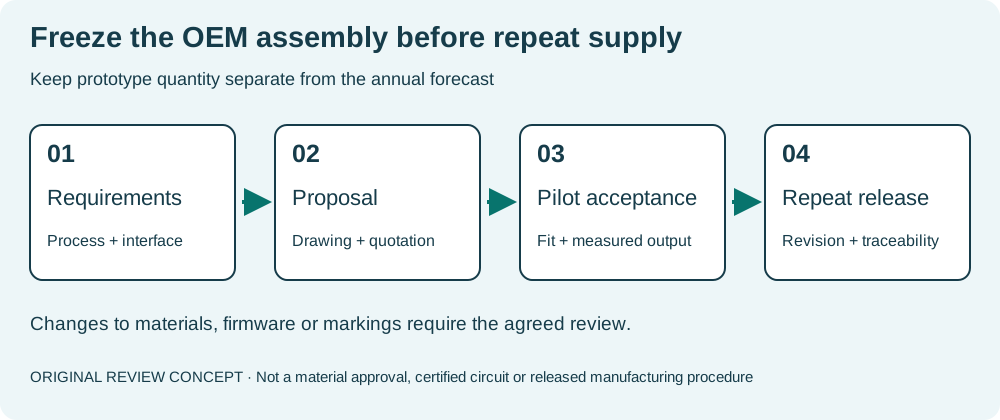
PROTOTYPE BEFORE PRODUCTION
Agree process, geometry, interface, approval needs, annual forecast and the first sample quantity. Identify unresolved inputs explicitly.
Agree the proposed construction, drawing revision, protocol, material schedule, engineering charges, sample cost and documentary scope.
Record dimensional fit, reference-pressure/level checks, output and logger/PLC integration. Include thermal, chemical or approval evidence appropriate to the agreed duty.
Approve identification, revision control, serial traceability, packing, acceptance limits and change notification before a production order.
Low-voltage ratiometric, I2C, special connectors or private firmware are feasibility requests. They are not released output options merely because an RFQ mentions them. Provide supply tolerances, cable length, EMC environment, power cycle and host-side specification. Keep the requested interface in the OEM brief until a compatible assembly and test method are agreed.
Laser marking and customer part numbering also need approval of the actual identity and traceability scheme. For approval-bearing equipment, verify the certificate holder, exact model and permitted identification before requesting any change. An OEM logo, an NDA or a supplier certificate does not create a new own-brand approval.
| Commercial question | What the quotation should settle |
|---|---|
| Prototype / batch minimum | Feasible sample quantity and minimum batch for the selected construction |
| Marking / setup / NRE | Artwork, fixtures, electronics development, testing and any recurring charge |
| Sample and production timing | Document review, component availability, configured manufacture/test and delivery estimate |
| Recurring supply changes | Drawing/firmware revision, substituted materials, test method, approval and change-notification rules |
No fixed MOQ, free engraving threshold, confidentiality-signing deadline or universal manufacturing lead time is stated without agreement. Request the scope that matters to your platform and evaluate the actual proposal.
Open starting documents; configured CAD, pinout and issued unit records remain specific to the approved assembly.
Define actual measurement points, conditions, traceability and material/approval records before pilot release.
Agree manufacturing, shipment, payment and warranty scope for the selected supply.
Yes, you can request one. Feasibility, sample charges and any minimum production batch depend on the configured construction and written quotation.
Marking scope, setup and recurring charges are confirmed in the quotation. No universal free threshold is claimed.
They are custom feasibility requests. Confirm supply, output, protocol, cable length, timing and complete integration before treating a variant as released.
Use the private RFQ attachments and agree any required confidentiality terms before sharing information that depends on them. The website does not automatically sign an NDA.
Review the exact certificate/model and permitted equipment identification first. Do not assume a supplier approval transfers to a renamed product.
Freeze the accepted drawing, material/electrical specification, test criteria, identification and change-control terms, then place the agreed production order.
RESOLVE THE MISSING SPECIFICATION
Search liquid review paths, compare PUR, PE and FEP cable, and prepare a complete wetted-material request with temperature, seals and concentration.
Find original WIKA, KELLER, Endress+Hauser, VEGA, Dwyer, Druck and Siemens models, then send a configuration-specific replacement review.
Prepare an OEM hydrostatic probe brief: custom span, density, continuous vented cable, electronics, marking, pilot acceptance and production documents.
RETURN TO THE ACTUAL APPLICATION