08 / HOT LIQUID & THERMAL CYCLING / SLV-HT
High-Temperature Submersible Level Transmitter Selection
Request a qualified immersion assembly for hot liquid tanks and compatible cleaning cycles, with separate limits for the cell, seals, cable and electronics.
FEP cable target · whole-assembly thermal qualification
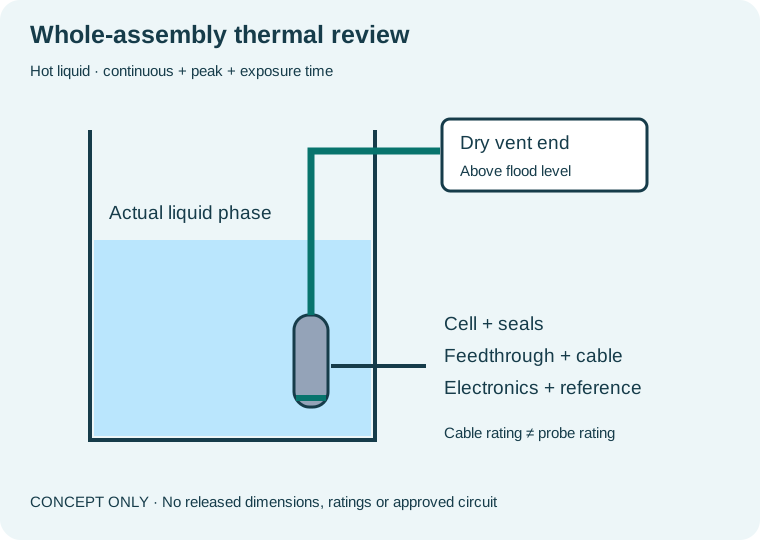
Atmospheric hot-water tanks and cooled condensate receivers
A cable temperature rating cannot qualify the whole probe.
Atmospheric water boils near 100°C at sea level and at lower temperatures at altitude. A 125°C request needs actual liquid and vessel conditions reviewed. Pressurized boiler differential-pressure systems are outside this single-probe catalogue.
Define the configuration before the quotation
- 100–125°C is a qualification request, not a released SLV operating limit. State continuous temperature, peak temperature and exposure time.
- Request 1–50 m head spans and two-wire 4–20 mA; confirm the pressure-reference architecture, thermal compensation and electronics location.
- CIP exposure requires the actual cleaning composition, temperature and duration; no sanitary or food-contact approval is implied.
THREE INPUTS THAT MAKE THE REVIEW USEFUL
Bring the installation into the specification.
Vessel pressure, liquid phase and actual process density
Cell, seals, cable, feedthrough and compensated-temperature records
SPECIFY THE CONFIGURED ASSEMBLY
Range, materials and cable requirements for SLV-HT.
| Selection item | Request / option | Release check |
|---|---|---|
| Temperature duty | Continuous/peak liquid temperature, duration and cycle | 100–125°C target requires complete assembly qualification. |
| Head span | Request 1–50 m and actual hot-liquid density | Do not calculate hot-water level using an unverified room-temperature density. |
| Pressure reference | Vented gauge target; confirm final architecture | An absolute-pressure alternative needs separate atmospheric compensation and system review. |
| Cable and seals | FEP jacket and qualified seals/feedthrough | A cable-only temperature rating does not establish cell, seal or electronics limits. |
| Output and evidence | Two-wire 4–20 mA; thermal compensation and immersion evidence | Confirm test conditions, drift and permitted peak/continuous exposures. |
Confirm the liquid remains in the intended phase and the vessel is atmospheric before selecting a single vented probe.
Cleaning peaks and repeated thermal shocks can be more demanding than steady-state tank temperature.
Do not reinterpret an ordinary guarded-nose water probe as a high-temperature version based on appearance.
Selection brief, not an issued manufacturing drawing, serial calibration certificate or blanket product approval. Confirm the exact release documents with the quotation.
INDEPENDENT TECHNICAL REFERENCES
Read the reference alongside its limits.
Independent reference: the MicroSensor MPM4810 page lists high-temperature measurement with an absolute-pressure architecture. This is not evidence for a vented-gauge SLV-HT assembly. Confirm the pressure reference and thermal records for the exact proposed unit.
Third-party names identify independent sources. No affiliation, supplied-equipment approval or performance equivalence is claimed. Reviewed 17 November 2026.
READ THE INSTALLATION BEFORE THE SIGNAL
Keep a dry atmospheric reference and a stable sensor datum.
A fixed probe reads the liquid column above its diaphragm. Cable length covers the physical route to a dry termination. Neither a pipe-size label nor an image establishes the assembly dimensions.
Download installation & loop-load worksheet ↓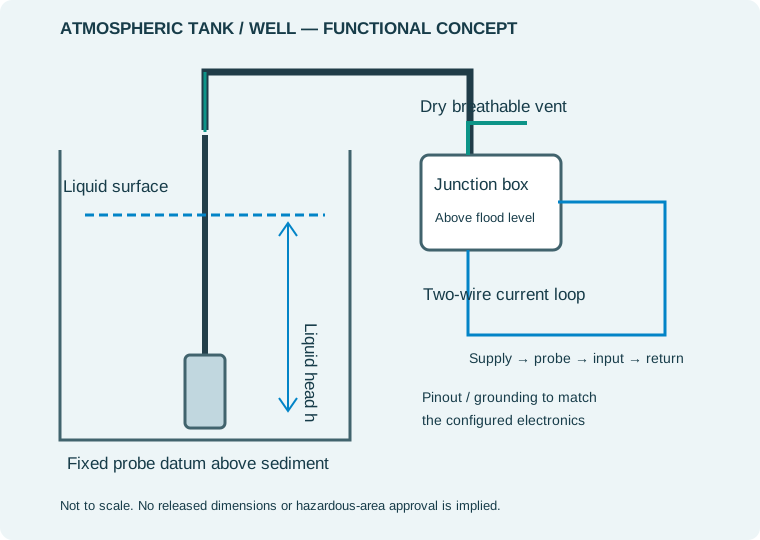
CONFIGURE YOUR PROBE & TERMINATION
One complete specification.
One clear quote request.
Set liquid head, density, signal and the installed cable route. The configuration code carries these choices into your engineering request.
ENQUIRY CONFIGURATION CODE
Indicative allowance per probe kit$84Probe, freight and tax excluded. Length prices apply to a matched base assembly; no generic first-5m FEP upgrade is free.
This code requests a configuration; the written quotation defines released dimensions, materials, approvals and availability.
Include this configuration in my RFQ ↗START WITH YOUR INSTALLATION
Four operating environments, four different selection decisions.
Chemical dosing tanks →
Specify chemical submersible probes from concentration, temperature, complete wetted materials and actual liquid density.
Generator fuel tanks →
Define low-head diesel tank measurement with fuel blend, usable level, cable route, area classification and generator input.
Groundwater & telemetry →
Plan groundwater pressure span, deployment cable, surveyed datum and low-power logger integration for borehole networks.
Lift stations & CSO →
Select a wastewater hydrostatic probe around rags, grease, turbulence, cleaning access, vent protection and pump-control acceptance.
KEEP THE WHOLE LOOP IN VIEW
From probe selection to dry cable termination.
Before you specify SLV-HT
Is this a released stock model?
SLV-HT identifies an enquiry configuration family. Ask for the exact configured datasheet, materials, drawing and calibration acceptance criteria before placing an order.
Can I order cable length independently from range?
Yes, specify both independently. Cable must cover the installed route and service allowance; measuring range covers liquid head above the probe. The quote confirms maximum immersion and cable load.
START WITH THE INSTALLATION
Liquid. Depth. Cable. Signal.
Send these four inputs to start a configuration review.