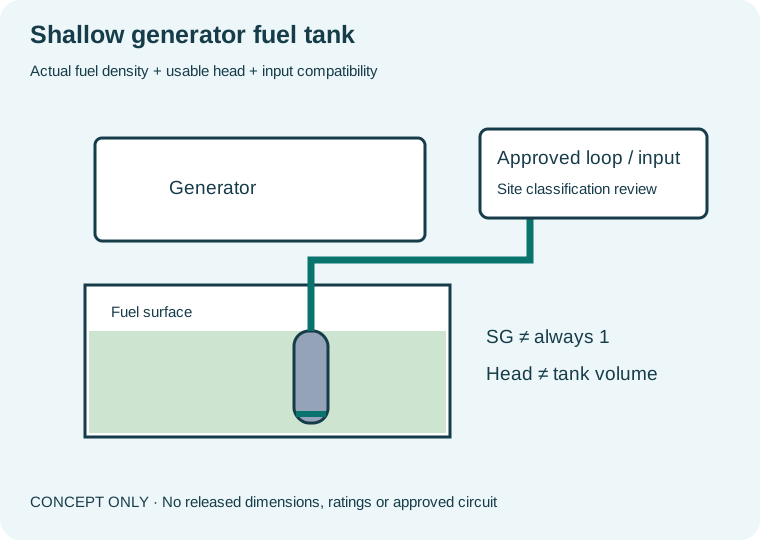
A shallow belly tank needs a well-defined low-pressure span. Fuel compatibility, hazardous-area requirements and the generator input are separate decisions.
Original system concept. Not an installed customer project or released assembly drawing.
RESOLVE THESE DECISIONS BEFORE ORDERING
Generator fuel tanks: define the measurement and its surroundings.
Resolve the fuel and hazardous area
State diesel specification, HVO or biodiesel blend, contaminants and temperature. Obtain classification from the responsible site designer. Diesel service alone does not determine the area classification or approval regime.
Measure usable head before setting alarms
Place the diaphragm at a documented datum clear of sediment and moving equipment. Confirm tank internal clearance, access opening, probe length and cable bend radius for vertical or horizontal mounting. Determine minimum submerged level, unusable heel and highest operating level. Indication is one input to the site fuel-management design.
Match the generator controller input
Confirm current input, loop supply, input resistance and scaling. A barrier can add voltage drop. Review the complete circuit and locate ordinary displays appropriately; an accessory checkbox does not create a certified loop.
WORKED EXAMPLE — ASSUMPTIONS, NOT A CUSTOMER CASE
Illustrative 0.6 m fuel head: avoid a water-density scaling error
Assume an atmospheric tank, maximum head 0.6 m above the probe and actual fuel SG 0.84.
P = 0.84 × 9.80665 × 0.6 = 4.9426 kPa. At that pressure, water scaling would display 0.504 m, 16% below the actual 0.6 m.
Choose a span and uncertainty suitable for low head, then scale the controller using the agreed density and datum. Volume in a shaped belly tank needs a strapping table. SG 0.84 is illustrative; confirm the supplied fuel at temperature.
SLV-EX is an enquiry family, not certified equipment. Where approval is required, accept the exact model, certificate scope, installation documents and circuit before purchase release or installation. ATEX, IECEx and North American requirements are separate.
Attach your installed nameplate, tank or well drawing, and input specification to the RFQ. Unresolved values can be stated as unknown for engineering review.
Questions about generator fuel tanks
Does diesel always require an intrinsically safe probe?
The site classification and applicable installation requirements determine the equipment. Provide the classification or ask the responsible site engineer to establish it.
Can this probe control pump start and stop?
Request the controller input, relay logic, failure response and independent protection design. The probe supplies a measurement; the whole control system requires separate review.
START WITH YOUR INSTALLATION
Four operating environments, four different selection decisions.