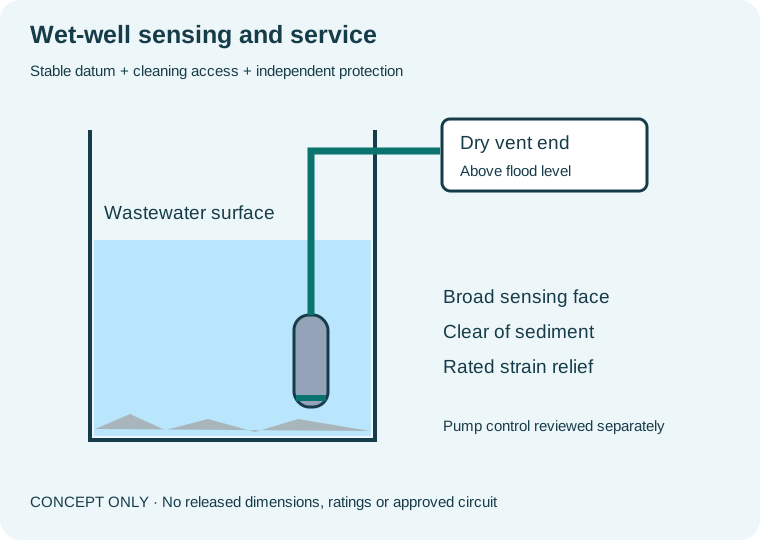
Original system concept. Not an installed customer project or released assembly drawing.
RESOLVE THESE DECISIONS BEFORE ORDERING
Lift stations & CSO: define the measurement and its surroundings.
Select the face for the actual fouling
Describe rags, wipes, grease, grit and settled sludge. A broad flush diaphragm can reduce debris-catching recesses but needs inspection. Guarded inlets and bird-cage arrangements have different cleaning and impact considerations.
Control movement without loading the vent tube
Keep the probe away from direct pump inflow and likely sediment accumulation. Review weighted bodies, restraint, rated clamps and retrieval access. Suspension force must not be carried by terminals, conductors or the atmospheric tube.
Review measurement and protection separately
Define scaling, filtering, thresholds, loss-of-signal actions and pump sequencing. An ordinary indicator or controller is not automatically independent overflow protection. Determine classified-location requirements for the installation.
WORKED EXAMPLE — ASSUMPTIONS, NOT A CUSTOMER CASE
Illustrative 4 m wet-well head with an elevated datum
Assume the diaphragm is 0.5 m above the floor and maximum measured liquid column above it is 4 m. Use SG 1 for this example.
P = 1 × 9.80665 × 4 = 39.2266 kPa. Corresponding liquid elevation is 4.5 m above the floor because the diaphragm datum is 0.5 m higher.
Controller scaling needs the datum offset. Below the diaphragm, the submerged probe cannot report the remaining heel accurately. Verify cleaning access and test agreed alarm responses using the actual installation and independent safeguards.
No sensor is guaranteed never to clog. CSO recording needs its own datum, sampling, timestamps and reporting method. A probe/controller bundle does not establish a compliant overflow-monitoring system.
Attach your installed nameplate, tank or well drawing, and input specification to the RFQ. Unresolved values can be stated as unknown for engineering review.
Questions about lift stations & cso
Is a guarded nose the same as a flush face?
No. Request the construction drawing and diaphragm geometry. The guarded-nose reference photograph is different from the flush-face enquiry concept.
Can a probe replace independent high-level protection?
The responsible designer must assess the complete protection system. A shared sensing element can create common failure modes; this page does not approve that architecture.
START WITH YOUR INSTALLATION
Four operating environments, four different selection decisions.