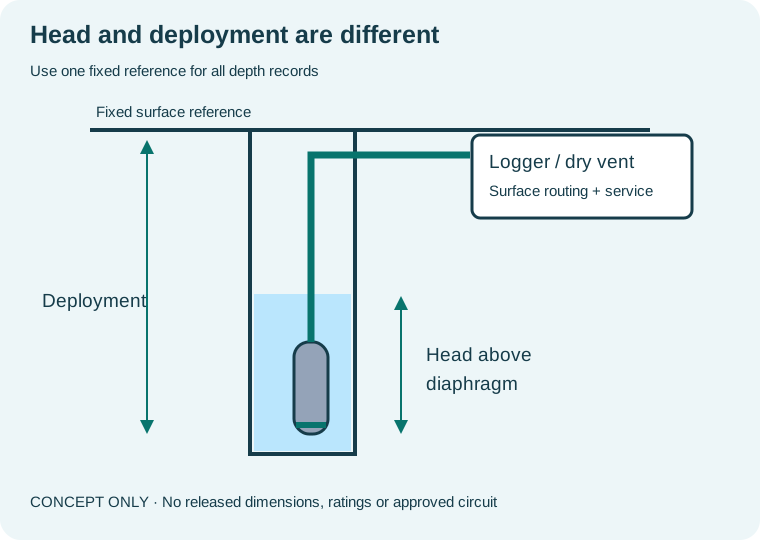
A pressure probe measures water column above its diaphragm. Your monitoring record also needs a fixed datum, atmospheric reference, timestamp and logger integration.
Original system concept. Not an installed customer project or released assembly drawing.
RESOLVE THESE DECISIONS BEFORE ORDERING
Groundwater & telemetry: define the measurement and its surroundings.
Separate three different depths
Record depth to water below a fixed reference, sensor deployment depth and head above the sensor. Pressure span follows maximum head; cable follows the installed path. Check narrow casing joints against the actual drawing.
Treat SDI-12 and Modbus as different integrations
Provide logger make/model, supply, supported protocol version, commands or register map, temperature channel and units. Define addressing and layout. SDI-12 is not an RS485 electrical interface. Long cables require capacitance, voltage-drop and topology review; assess RS485 as an alternative and require an integration test.
Budget energy over the measurement cycle
Include sleep, wake-up, settling, measurement, communication and retries, plus logger and modem. Batteries, charging and coverage affect field life. Obtain measured current/timing data for the exact assembly.
WORKED EXAMPLE — ASSUMPTIONS, NOT A CUSTOMER CASE
Illustrative sensor at 180 m with a 30 m water column
Assume the diaphragm is 180 m below the reference and the water surface is 150 m below that same point. Fresh-water SG is assumed to be 1.
Head = 180 − 150 = 30 m. P = 1 × 9.80665 × 30 = 294.1995 kPa. A 180 m cable is insufficient once surface routing and service allowance are added.
A 200 m cable request could cover deployment 180 m + surface route 15 m + service allowance 5 m. Range must cover future high-water levels; the assembly must withstand maximum submergence. Record the fixed probe position: moving it changes inferred depth-to-water.
SGMA-related obligations depend on the applicable monitoring program and agency requirements. A sensor does not establish compliance. Absolute sensors require separate barometric correction; verify the pressure reference before applying a vented-probe workflow.
Attach your installed nameplate, tank or well drawing, and input specification to the RFQ. Unresolved values can be stated as unknown for engineering review.
Questions about groundwater & telemetry
Is measuring range equal to drilled well depth?
No. Range follows water column above the diaphragm. Deployment, route, mechanical load and maximum submergence are separate specifications.
Does the sensor include cellular telemetry?
This family covers sensing and the selected local logger interface. Modem, radio plan, SIM, cloud service and energy storage are separate project scope.
Reference your groundwater records to a fixed datum.
USGS guidance explains why observation-well records include construction, location and the water-level measurement datum. The project monitoring plan determines the required records and acceptance procedure.